


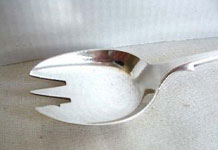
A runcible spoon and a classic tribute to interspecies romance.
March 26, 2012
The aim of National Poetry Month is to encourage people to enjoy poetry. Though the aim is noble, I think we sometimes, with the best of intentions, ‘kill off’ the very poetry we are tying to encourage people to love. All too often poems feel like codes that need to be cracked. I personally meet way too many poems that I don’t understand and therefore I don’t like. I believe a poem can say what it means and it is not the reader’s job to figure out what the poet is really saying. No wonder poetry doesn’t have a bigger audience. All that code cracking. Who has the time—or the desire?
Having said that, I love meeting a word inside a poem that I do not know. I often fall in love with a word that I don’t know the meaning of, but I do know I love the word. For example. The Owl and the Pussycat is Edward Lear’s classic tribute to interspecies romance. Two lovers elope in a pea-green boat and after a voyage of a year and a day, are married and dine “on mince, and slices of quince,/ Which they ate with a runcible spoon.” and they dance by the light of the moon.
Does it matter if you don’t know what exactly is a runcible spoon? The definition of this term is a small fork with three prongs, one having a sharp edge, and curved like a spoon. However, I don’t believe that knowledge is critical to loving this whimsical poem. Here is the poem to love and as an added bonus—you now know about runcible spoons.
The Owl and the Pussycat went to sea
In a beautiful pea-green boat,
They took some honey, and plenty of money,
Wrapped up in a five pound note.
The Owl looked up to the stars above,
And sang to a small guitar,
“O lovely Pussy! O Pussy, my love,
What a beautiful Pussy you are, you are, you are,
What a beautiful Pussy you are.”
Pussy said to the Owl “You elegant fowl,
How charmingly sweet you sing.
O let us be married, too long we have tarried;
But what shall we do for a ring?”
They sailed away, for a year and a day,
To the land where the Bong-tree grows,
And there in a wood a Piggy-wig stood
With a ring at the end of his nose, his nose, his nose,
With a ring at the end of his nose.
“Dear Pig, are you willing to sell for one shilling your ring?”
Said the Piggy, “I will”
So they took it away, and were married next day
By the Turkey who lives on the hill.
They dined on mince, and slices of quince,
Which they ate with a runcible spoon.
And hand in hand, on the edge of the sand.
They danced by the light of the moon, the moon, the moon,
They danced by the light of the moon.
In the end, poetry will appeal to people if they grow to love it. Lets help children fall in love with poetry!
TAKE TIME.
March 16, 2012

Reading demands engagement and is most definitely not a passive activity. A rendezvous with a book demands that you let go of all distractions. Pico Iyer’s essay, ” The Joy of Quiet” http://www.nytimes.com/2012/01/01/opinion/sunday/the-joy-of-quiet.html?_r=1&scp=1&sq=Joy of Quiet&st=cse is a plea for stillness. He says: “In barely one generation we’ve moved from exulting in the time-saving devices that […]
Distraction— a drawback of reading a book on a device.
March 6, 2012
A recent article in the NYT, “Finding your Book Interrupted…By the Tablet You Read It on.” http://www.nytimes.com/2012/03/05/business/media/e-books-on-tablets-fight-digital-distractions.html?_r=1&ref=books calls attention to some of the drawbacks of reading on a device. “Finding your Book Interrupted” speaks to the distracting nature of reading on a device. Children reading books they hold in their hands encourage then to acquire […]
The Cat in the Hat was a book that changed the way kids learned to read.
March 2, 2012
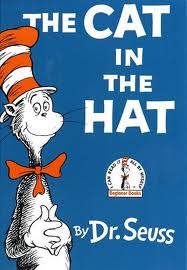
Theodor Seuss Geisel (3.2.1904), best known as Dr. Seuss is credited with “killing off” the Dick and Jane Books by creating the first I Can Read book in 1957. Here is the back story to how The Cat in the Hat came to be written. In 1954 John Hersey wrote an article in Life Magazine […]
Don’t even think of allowing your child to leave childhood behind without experiencing the sheer delight of the Frances books.
March 1, 2012
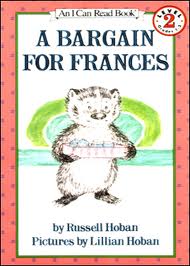
Russell Hoban, author of more than fifty books for children, including some true classics of children’s literature, died December 13,2011. His book, A Bargain for Frances is one of those books I will always remember, as much for the story line a for the conversation the book prompted. Badgers, Thelma and Frances are best friends […]

